On a gym ball, a simple pump becomes a full core exercise: the body recruits dozens of stabilizing muscles to avoid tipping over. We exploit this instability to work deeply, provided we choose the right movements and understand what the ball really offers compared to the floor or a traditional bench.
Gym ball and muscle gain: what instability really changes
Before listing exercises, we need to set a framework. The ball engages the core more than the main muscle groups. Research on unstable training shows that the electromyographic activation of the abdominals and stabilizers increases, but the force produced by the pectorals, shoulders, or quadriceps decreases compared to a stable surface.
In practical terms, you won’t be able to push as heavy on a ball as on a bench. The mechanical tension applied to the large muscle groups is lower, which limits progressive overload. For someone seeking pure hypertrophy in the legs or back, the ball is not the first tool to grab.
On the other hand, to strengthen the abdominal belt, improve postural endurance, and reinforce the deep muscles of the back, the gym ball is remarkably effective. You can also read So Sports’ advice to delve deeper into choosing movements suited to your level.
Hip bridge on gym ball: maximum activation of the hamstrings
Lie on the ground with your feet on top of the ball, arms along your body. Push your hips towards the ceiling until your knees, pelvis, and shoulders are aligned, then slowly lower back down without letting your buttocks touch the ground between repetitions.
The ball forces the hamstrings to stabilize the knee constantly. On a fixed surface, these muscles mainly work concentrically. Here, they must resist the micro-lateral movements of the ball, which generates additional eccentric work.
Variation to intensify the movement
Once in the high position, pull the ball towards your buttocks by bending your knees (leg curl on the ball). The movement combines hip extension and knee flexion, two main functions of the hamstrings, into a single exercise.
Push-ups on the ball: strengthening shoulders and core simultaneously
Place your hands on the sides of the ball, fingers pointing forward. Lower your torso while controlling the flexion of your elbows, then push back up.
The unstable surface reduces the force that the pectorals can produce, but the work of the shoulders and stabilizing muscles of the scapula increases significantly. Here, we target the serratus anterior, rotator cuff muscles, and deep abdominals more than with traditional push-ups.
- Keep elbows close (45-degree angle relative to the torso) to protect the shoulder joint on a mobile surface
- Engage the abdominals before each descent to lock the pelvis and prevent the back from arching
- Slow down the eccentric phase (descending over 3 seconds) to increase time under tension despite the absence of external load
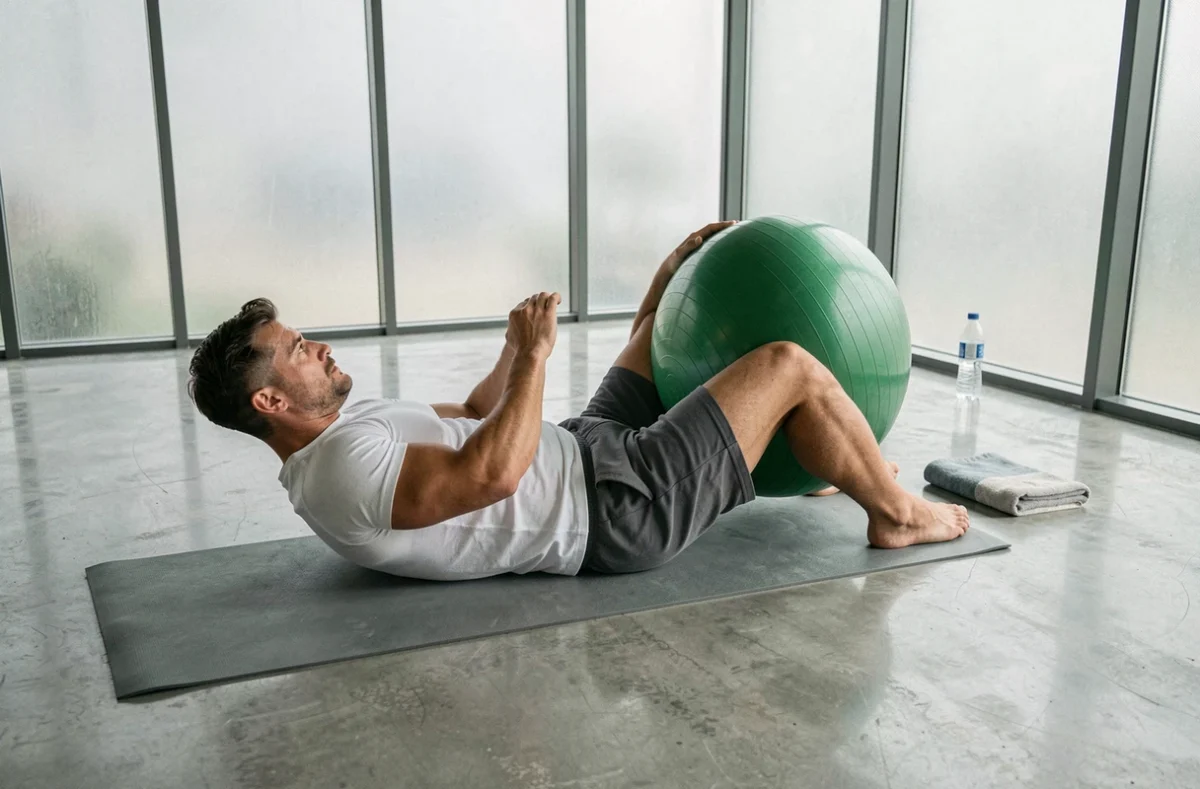
Crunch on gym ball: range and safety for the abdominals
The lower back is supported on the ball, feet flat on the ground, hands behind the head. Curl the torso forward while exhaling, then lower back down while following the movement until you feel a slight stretch in the abdominals.
The ball allows for a greater range of motion than a floor crunch. The back conforms to the curvature of the ball during the extension phase, which stretches the rectus abdominis before contraction. This additional range engages the fibers over a larger portion of their length, a parameter favorable for strengthening.
Pelvis positioning
The further you move your buttocks towards the ground (lower pelvis on the ball), the longer the lever and the more demanding the exercise. Conversely, raising your hips on the ball reduces the difficulty. Adjust according to your level without adding weight.
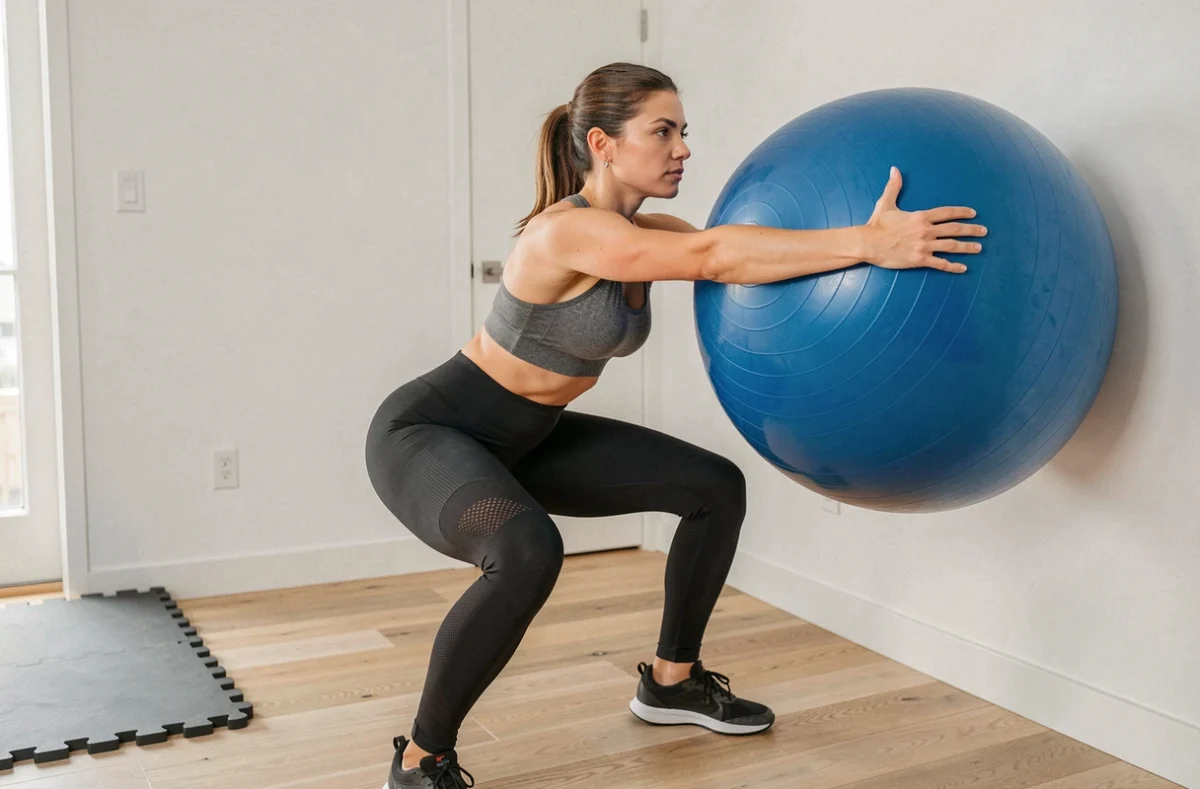
Wall squat with ball: targeting the quadriceps without heavy equipment
Place the ball between your back and a wall, feet slightly forward. Lower into a squat until your thighs are parallel to the ground, then rise by pushing through your heels.
The ball rolls against the wall during the descent, guiding the movement and keeping the back straight. For those with lower back pain during free squats, this is an alternative that reduces strain on the spine while loading the quadriceps.
Holding the low position for 20 to 30 seconds between certain repetitions turns the exercise into isometric work. Opinions vary on the benefit of isometric work alone for muscle gain, but combined with dynamic repetitions, it increases the total time under tension for the set.
Front roll on the ball: dynamic core stabilization for the whole body
Kneel facing the ball, forearms resting on it. Roll the ball forward by extending your arms, then bring it back by contracting your abdominals. The movement resembles an abdominal wheel, with a wider and less aggressive support for the shoulders.
- Do not exceed the range where the lower back starts to arch: this is the useful limit of the movement
- Exhale fully during the return phase to enhance abdominal contraction
- Move the knees forward a few centimeters to increase difficulty (the further the support point is, the longer the lever)
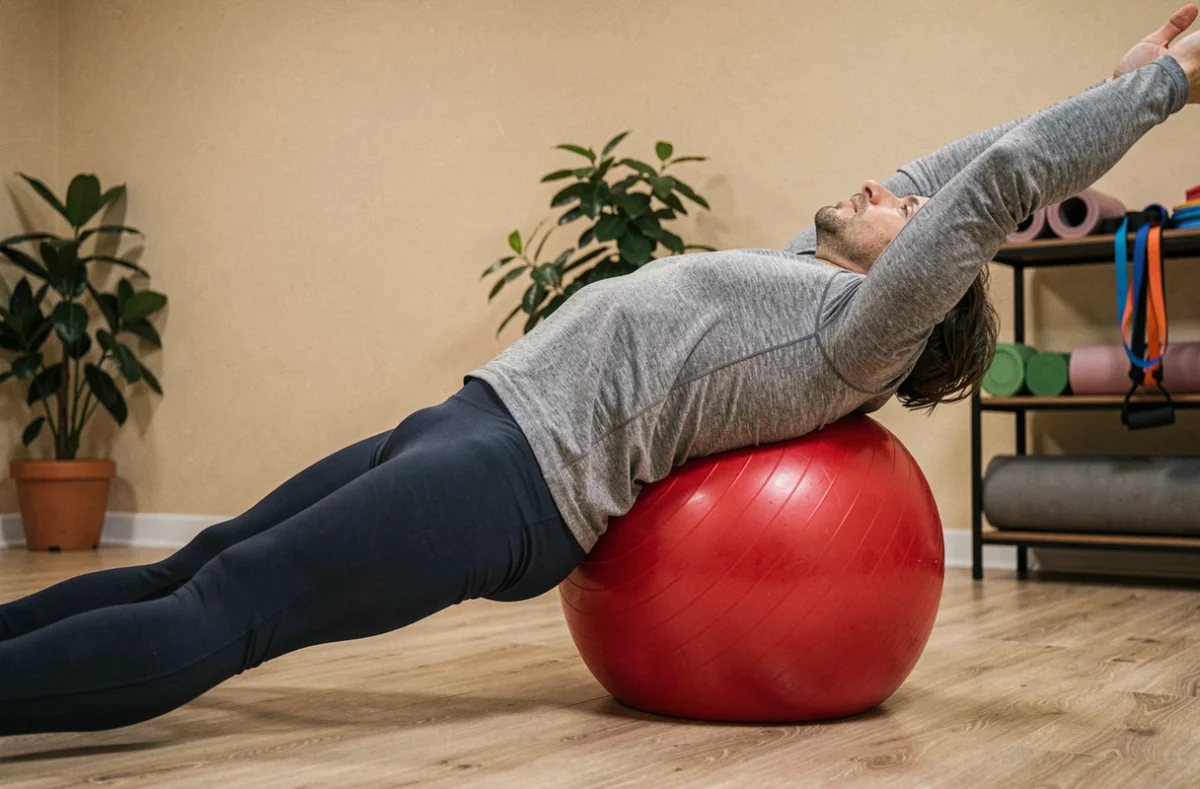
This movement simultaneously engages the abdominals, shoulders, and lats, making it a full-body stabilization exercise rather than isolating a single muscle group.
Frequency and progression on the gym ball
Two to three sessions per week are sufficient to progress on these exercises. Increase difficulty by adjusting tempo (slower descents), the number of repetitions, or unilateral variations rather than adding weight. The ball remains a tool for deep strengthening and stability. For heavy overload, we return to the bench and bar.
The most effective approach is to integrate two or three of these movements into an existing routine, in addition to classic floor exercises or with free weights. The gym ball does not replace weights, but it fills a gap that weights do not cover: motor control in instability and postural endurance of the core.