
Some professions require standing and moving for an entire workday. Long-distance hikers, postal workers, waiters, maintenance workers: walking eight hours a day is not a fitness goal, it’s a daily reality for millions of people. Understanding what this duration does to the body allows one to make the most of it, and above all, to avoid damage.
Walking Benefits Threshold: What Recent Research Says
The WHO recommends 150 to 300 minutes of moderate activity per week, supplemented by muscle strengthening at least two days a week. Eight hours of daily walking far exceed this framework.
A meta-analysis published in The Lancet Public Health on July 23, 2025, covering 57 studies, shows that the most significant benefits appear around 7,000 steps per day. Beyond that, the gains in mortality, dementia, depression, and falls tend to plateau. Eight hours of walking represent far more than 7,000 steps.
This does not mean that prolonged walking is harmful. But much of what can be expected in terms of cardiovascular or cognitive protection is already achieved with a fraction of this volume. Knowing the effects of walking eight hours a day helps to distinguish what constitutes real benefit and what constitutes excess.
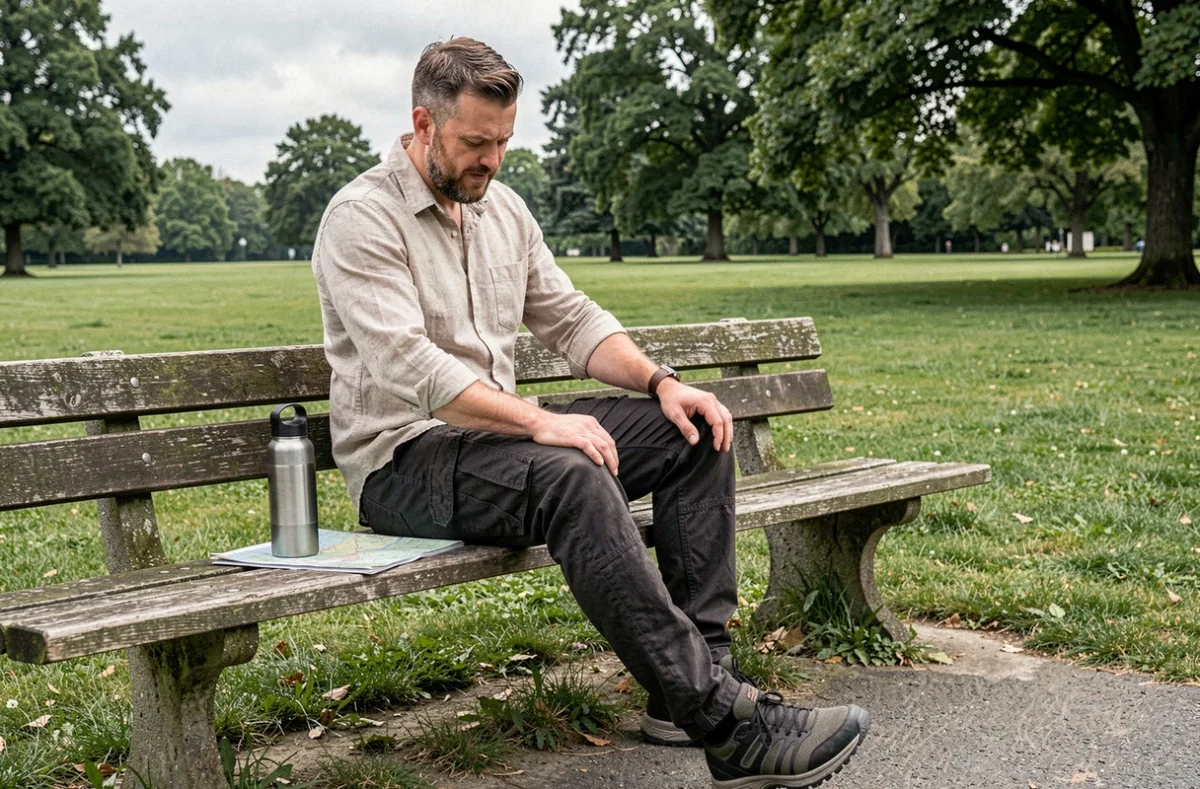
Musculoskeletal Risks of Prolonged Walking
Have you ever felt a dull pain under your heel after a long day on your feet? This type of signal is the first warning from a body that is enduring too many repetitive strains.
Joints and Tendons Under Pressure
The main risk of such prolonged walking is musculoskeletal. Individuals with good cardiovascular health do not face particular heart risks from walking for long periods. However, the joint and tendon structures endure considerable cumulative mechanical stress.
Plantar fasciitis, Achilles tendinopathy, and tibial periostitis are among the most common conditions in long-distance walkers. The issue is not the intensity of a single step, but the repetition over thousands of cycles.
Concrete Aggravating Factors
- Inappropriate or worn shoes poorly absorb shocks and distort support, which accelerates fatigue in the foot and knee structures.
- A hard surface (concrete, industrial tile) multiplies micro-impacts compared to a soft ground or dirt path.
- The absence of sitting breaks prevents lumbar disc decompression, which promotes back pain by the end of the day.
Being overweight is a direct aggravating factor: each additional kilogram increases the load on the knees with every step. Over eight hours, this overload becomes significant.
Long Walking and Caloric Expenditure: A Nuanced Calculation
Walking eight hours burns a lot of calories, there’s no denying that. But actual caloric expenditure depends on weight, pace, and elevation. A slow walk on flat terrain consumes much less energy than a brisk hike in the mountains.
A common pitfall: compensating for this expenditure with excessive eating. The body sends intense hunger signals after prolonged effort. Without attention, caloric intake exceeds expenditure, and the hoped-for weight loss does not occur.
Another rarely mentioned point: walking alone does not develop muscle mass. It primarily engages the lower limbs in endurance. The upper body, trunk stabilizing muscles, and overall strength do not progress. The WHO actually recommends muscle strengthening as a complement, precisely for this reason.

Adapting Your Practice to Walk Long Without Injury
If your daily routine requires eight hours of walking, a few adjustments can significantly reduce the risk of injury.
Alternating walking surfaces when possible limits mechanical monotony. Varying between hard ground and soft ground distributes stresses differently on the joints.
Footwear deserves special attention. A pair of walking shoes loses a significant part of its cushioning after several hundred kilometers. Replacing them regularly is not a luxury; it’s direct protection for the knees and back.
- Incorporate sitting breaks of five to ten minutes every two hours to decompress the lumbar discs.
- Stretch the calves, hamstrings, and plantar fascia at the end of the day to limit morning stiffness.
- Complement walking with two weekly sessions of muscle strengthening targeting the trunk and upper limbs.
Intensive walking does not compensate for all the consequences of a long sitting period during the rest of the day. A study published in Healthcare (volume 14, article 3208, 2026) highlights this point. Sitting for several hours after walking all day creates an alternating sedentary pattern that is not without effect.
Eight hours of daily walking are neither an ideal to achieve nor a catastrophe to avoid. For those who practice it out of professional necessity or a passion for hiking, the body adapts remarkably well, provided that its warning signals are respected. Proper shoes, muscle strengthening, and regular breaks transform a physical constraint into an overall protective activity.