Gravel remains one of the least expensive outdoor surfacing options per square metre. Prices can vary fivefold depending on the type of rock, the size of the aggregate and where you buy it. Understanding these differences can help you cut costs without ending up with unsuitable material that needs replacing two years later.
The hidden costs of gravel: what the price per bag doesn’t tell you
Comparing only the prices shown at garden centres or online can give you a misleading picture. The true cost of a gravelled area includes ground preparation, laying geotextile, bulk delivery and maintenance over several years.
Geotextile is often presented as a permanent solution to weeds, but it doesn’t eliminate the need for weeding. It blocks growth from below, but dust and organic debris build up on top, allowing windblown seeds to germinate. Regular, light cleaning costs less than replacing the entire fabric after a few seasons.
Before pulling everything up when a path starts turning green, check where the weeds are taking root. If they’re growing in the layer of debris on top of intact geotextile, a simple surface clean is all that’s needed. Buying cheap gravel for your garden makes little sense if you have to replace the entire layer every three years because of poor maintenance.
Crushed or rounded gravel: the choice that affects price and stability
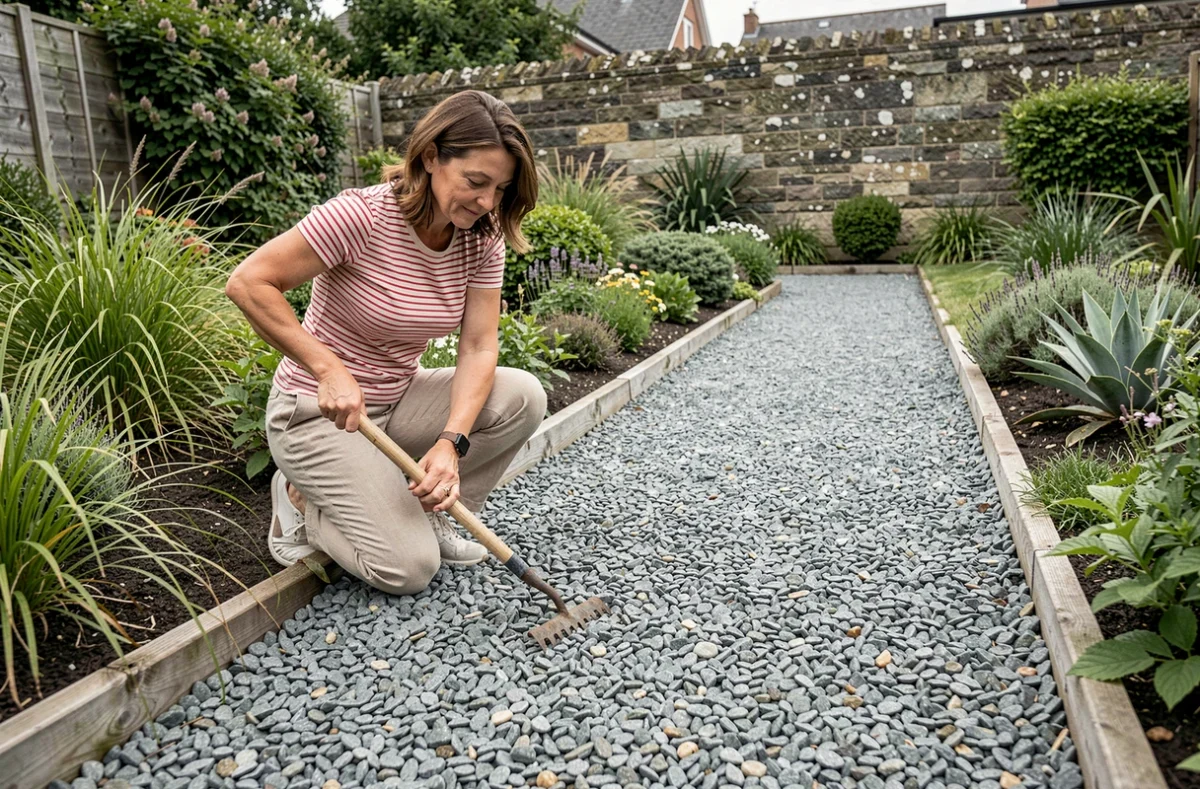
The shape of the gravel affects both its price and stability. Locally sourced crushed gravel from nearby quarries is generally cheaper than imported rounded gravel or decorative stone such as white marble or slate.
Crushed gravel has sharp edges that lock together. On a pedestrian or vehicle driveway, this helps prevent the aggregate from shifting underfoot or under wheels. Rounded gravel feels more comfortable to walk on, but shifts more easily, making it better suited to decorative areas around flower beds or at the base of trees.
Choosing the right size for your needs
Aggregate size affects both the price and the quantity required. Very fine or specialist sizes often cost more than standard grades.
- For a pedestrian path, 6/10 or 8/16 mm gravel offers a comfortable walking surface without rolling underfoot, provided it’s laid thick enough.
- For a vehicle area (driveway or parking space), 6/14 or 10/14 mm crushed gravel provides the stability needed for vehicles. Adding gravel grids reduces rutting but increases the initial cost.
- For purely decorative areas (around a pool or in flower beds), fine rounded gravel or white pebbles create a neat finish, but aren’t suitable for areas with frequent foot traffic.
Choosing the wrong size means having to top it up regularly. Gravel that’s too fine will scatter on a driveway, while gravel that’s too coarse makes a pedestrian path uncomfortable to walk on.
Recycled aggregates and local sourcing: two overlooked ways to save
The distance between the quarry and the site can have a major impact on the final bill. Delivery often accounts for a significant share of the total cost, especially for small quantities. Buying loose gravel directly from a building materials supplier or local quarry costs less than buying 25 kg bags from a DIY store.
Aggregates made from recycled materials (crushed concrete or reclaimed asphalt) are worth considering for sub-bases and paths that won’t be visible. They generally cost less than new natural gravel. However, their rough appearance makes them less suitable for decorative areas.
Bulk or bulk bag: look beyond the unit price
A bulk bag (around one tonne) offers much better value for money than individual bags. For an area of just a few square metres, bags are convenient. Once a project covers more than around ten square metres, buying loose or in a bulk bag significantly reduces the cost per tonne.
Watch out for delivery charges: some suppliers advertise an attractive price per tonne but charge extra for transport. Ask for a quote that includes delivery to make a fair comparison.
Local regulations and drainage: check before committing to the project
Gravel’s permeability is often highlighted as an advantage over concrete surfaces. Gravel does let water through, which helps limit runoff. But this permeability doesn’t guarantee compliance with local stormwater management rules.
Requirements for infiltration, water retention or runoff control may depend on the local planning regulations (PLU) or the municipality’s stormwater zoning. For a large driveway or courtyard project, checking these rules before buying gravel can save you from having to modify the installation later.
Drainage beneath the gravel
On clay soil or a slope, laying gravel directly on compacted earth can lead to puddles and destabilise the top layer. A free-draining sub-base (compacted all-in aggregate or road base) is then necessary. This foundation work, often overlooked in price comparisons, can cost as much as the decorative gravel itself.
Skipping the foundation to save money has the opposite effect: the gravel sinks, ruts form and you have to add more material every year.
Calculate how much gravel you need to avoid extra costs
Underestimating the quantity means placing another order and paying delivery charges again. Overestimating leaves you with partly used bulk bags taking up space in the garden.
- For a pedestrian path, a layer around 5 cm thick requires between 80 and 100 kg of gravel per square metre, depending on the density of the rock, according to supplier data.
- A vehicle area needs a thicker layer, increasing the quantity per square metre accordingly.
- Measure the actual area (length multiplied by width, minus any planted areas or borders) before requesting a quote to get an accurate figure.
It’s sensible to round the quantity up slightly: a small surplus is better than having to buy another half bulk bag and pay for delivery again.
Gravel that’s affordable and lasts starts with accurate calculations, local sourcing and proper ground preparation. Cutting corners on the sub-base or geotextile to lower the initial budget will cost you more in maintenance and repeated replacements.