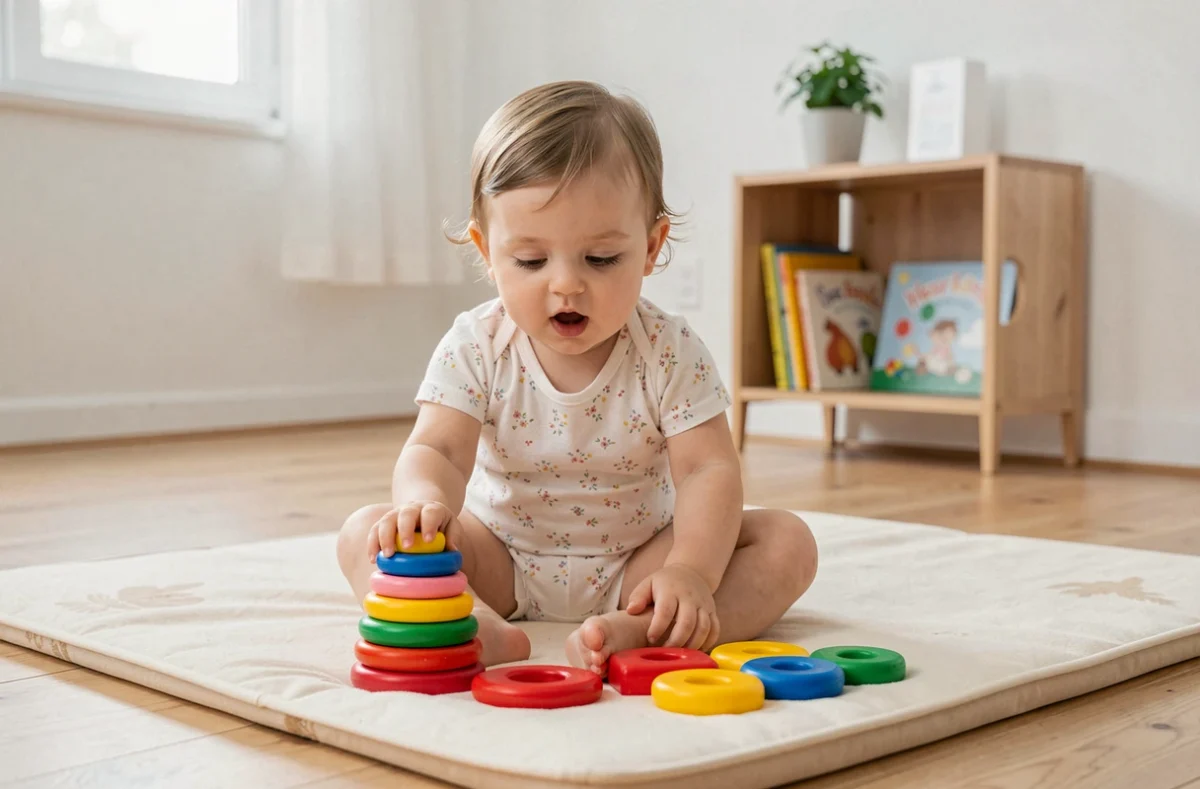
At twelve months, a child starts moving around on their feet, handling objects with increasing precision and imitating the gestures they observe. Their developmental toys support these motor and cognitive milestones, but having more toys does not guarantee better development.
The WHO recommends that children aged one to two get at least three hours of physical activity spread throughout the day, including free play and everyday movements. Choosing toys for a baby should therefore fit into this broader approach to movement and interaction.
Play space at one year: a few objects are enough to encourage development
Competitors go into great detail about toy categories (stacking, musical, sensory). Before buying anything, the most useful question is about the play environment itself. A one-year-old does not need a toy chest overflowing with toys to develop their curiosity: they need a clear space with a few accessible objects and an available adult.
A low basket containing three or four different objects (a wooden cup, a textured ball, a small board book, a stainless-steel spoon) already offers plenty to explore. The child chooses, handles, puts things down and comes back to them. Limiting the number of objects in view encourages concentration rather than flitting from one toy to another.
When you want to choose a toy for a one-year-old girl or boy, the most reliable criterion is how versatile it is: can it be used in several ways? A wooden block can be stacked, tapped, hidden under a cloth or carried in a container. An electronic toy that offers just one interaction (pressing a button to trigger a sound) quickly loses a child’s interest.
Fine motor skills and manipulative toys: what a 12-month-old’s hands can do
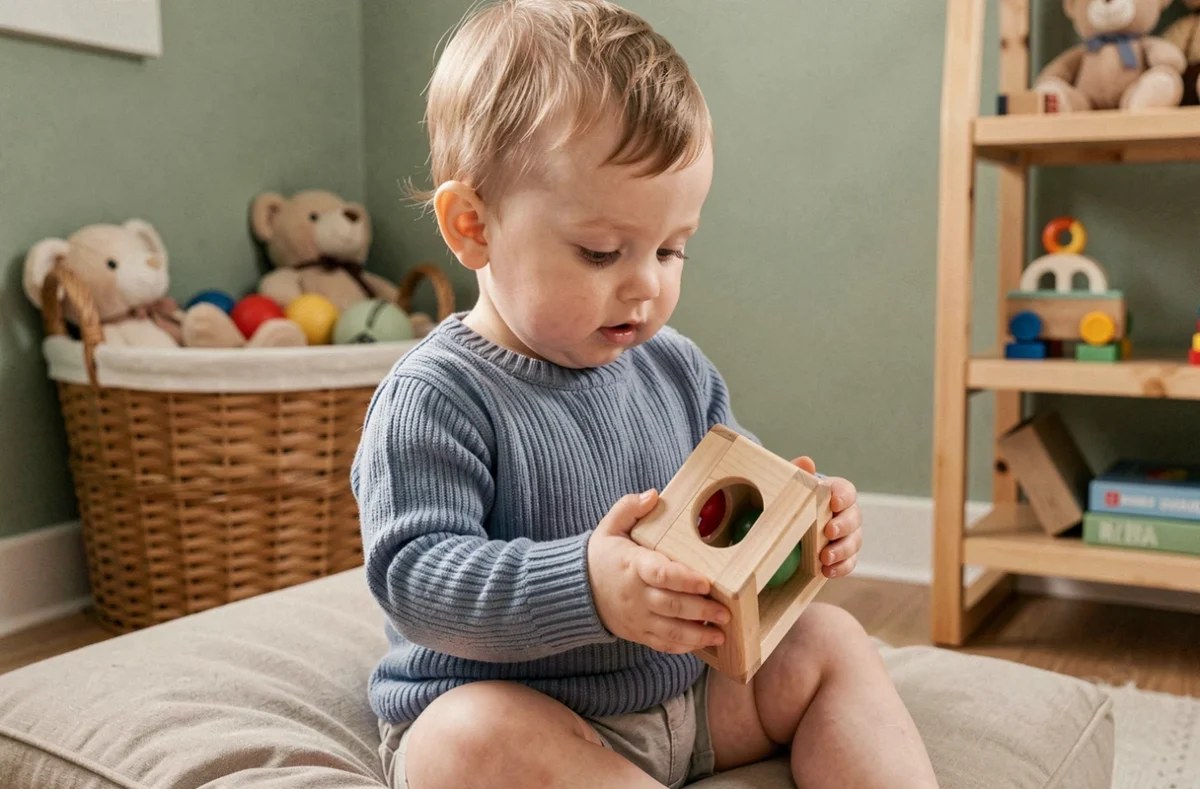
At one year, the pincer grasp between thumb and index finger becomes more precise. A child can pick up small objects, fit them into openings and slide them through a slot. Fine motor skills develop through free repetition, not through toy complexity.
Objects that work best at this stage share a few common features:
- Simple shapes to fit into a base (circle, square, triangle), made from natural wood or painted with paints that comply with toy safety standards
- Open containers (boxes, baskets, bowls) that children can use to transfer objects from one to another, an activity they can repeat endlessly
- Pull-along or push toys that combine movement with hand-and-arm coordination, useful as walking becomes steadier
- A variety of textures (fabric, smooth wood, soft rubber) that encourage sensory exploration without overwhelming the child
Wood remains the most durable and versatile material for this age group. A wooden shape sorter withstands knocks, needs no batteries and provides clear sensory feedback when a piece drops into place.
Toys and screens at one year: the guidelines make the choice clear
Some toys for toddlers include a small screen or offer additional video content through an app. The WHO does not recommend any sedentary screen time for a one-year-old. This guidance is clear and helps narrow down the options available.
Choosing screen-free toys follows this recommendation while encouraging physical manipulation and human interaction, two well-documented ways to support development. A mechanical musical toy (such as a tambourine or wooden xylophone) stimulates hearing and movement without introducing technology.
This is not a minor consideration: the range of connected toys for children under two grows every year. Checking whether a toy has a screen or relies on an app can help you avoid purchases that do not meet a baby’s actual needs at this age.
Toy safety: beyond the CE mark
The CE mark is mandatory, but it is not an absolute guarantee. Checking RappelConso lets you see whether a toy has been recalled because of a safety defect. The website sorts alerts by product category and provides the instructions associated with each recall.
For a one-year-old, the main things to watch for are detachable small parts (which pose a swallowing risk), non-compliant paints and magnetic components. Checking the toy’s condition each time it is used—especially fabric items, whose seams can come apart—is a useful addition to checking the age label.
Shared moments and free play: the adult’s role in a baby’s development
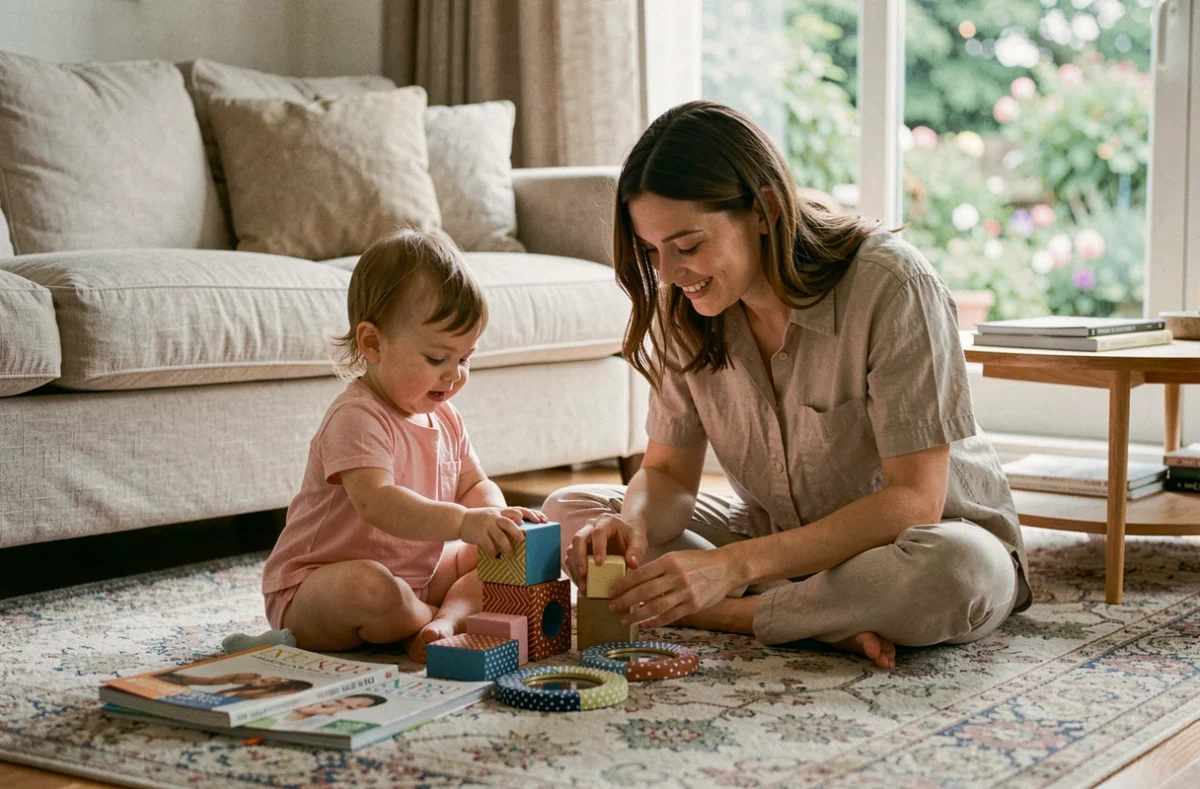
A toy left on its own in a playpen does not have the same effect as a toy used interactively. Naming the objects the child handles, commenting on their actions (“you put the block in the box”) and copying their movements: these verbal and physical exchanges enrich every play session.
Play shared between an adult and child remains the main driver of development at one year. A simple game of peekaboo with a cloth encourages object permanence, a cognitive skill that is developing rapidly at this age. Stacking three kitchen cups with an attentive parent offers just as much as a multifunctional activity tower used alone.
Everyday objects (a wooden spatula, a colander, a shoebox) also make excellent additions to store-bought toys. Their appeal lies in their new sensory qualities and lack of a predefined purpose: the child invents ways to use them, which fuels their curiosity.
Toy rotation: a simple, free approach
Instead of regularly buying new toys, put some objects away and bring them out again after a few weeks to renew the child’s interest. Rotation works because working memory is short at one year: a toy that has been out of sight for two weeks feels new again.
Three or four freely accessible objects, rotated every two to three weeks, are enough to maintain curiosity without cluttering the play space. This approach aligns with Montessori principles, which advocate a pared-back environment suited to the child’s pace.
European regulations on toy safety are expected to evolve in the coming years, but the rules currently in force remain the benchmark for any purchase. Paying attention to the space, shared time and simplicity of the objects on offer is a more reliable guide than price or brand when supporting a one-year-old’s development.