
A salaried driver finishes their shift at 7:12 p.m. Their payroll software expects a decimal duration, not hours and minutes. Entering 11.12 instead of 11.20 means shaving several minutes off their pay every day. For taxi professionals, mastering the conversion of minutes into hundredths helps prevent this kind of silent error from adding up over an entire month.
Service span and actual working time: two durations to convert separately
Online competitors offer generic converters. None distinguishes between the two concepts that industry regulations require to be kept separate: the service span and actual working time.
The service span covers the period between starting and finishing work. Actual working time includes driving, as well as waiting after picking up a client, which counts as work. Converting a start and end time into decimal format without separating these periods leads to an incorrect calculation, either to the employee’s disadvantage or at an additional cost to the employer.
In practice, note the start time (for example, 7:15 a.m.) and the end time (6:45 p.m.). Convert each time independently before calculating the difference. 7:15 a.m. becomes 7.25 in hundredths. 6:45 p.m. becomes 18.75. The decimal service span is therefore 18.75 – 7.25 = 11.50 hours. To calculate actual working time, subtract any unpaid breaks, also converted into hundredths.
The collective agreement requires an individual working-time record book. This book records durations, and converting an hour into hundredths makes it possible to complete this document without confusing base 60 with base 100.

How to convert hours into hundredths for taxi professionals
The formula fits on one line: divide the minutes by 60, then add the result to the whole hours. That’s all.
Take 9:40. Keep 9 as the whole-number part. Divide 40 by 60, which gives 0.67 (rounded to the nearest hundredth). The result is 9.67 decimal hours.
The most common payroll entry mistake
Confusing 9:40 with 9.40 is a classic mistake. In decimal format, 9.40 corresponds to 9 hours and 24 minutes, not 9 hours and 40 minutes. Over a working week, this discrepancy can significantly affect the calculation of overtime hours.
Overtime for salaried taxi drivers is subject to industry-specific thresholds. Applying the correct premium rate first requires an accurate total of hours worked. An inaccurate total caused by approximate conversions shifts when those thresholds are reached.
Key values to memorize
- 15 minutes = 0.25 h (a quarter of an hour, often used for regulated breaks)
- 30 minutes = 0.50 h (half an hour, a common basis for calculating waiting time)
- 45 minutes = 0.75 h (three quarters of an hour, often used for longer breaks)
- 10 minutes = 0.17 h and 20 minutes = 0.33 h (the trickiest rounded values when entering data quickly)
Remember these five reference values and you’ll cover most everyday situations. For values in between, dividing by 60 remains the only reliable method.
Overtime and hundredths: the trap of industry thresholds
Converting correctly is not enough to determine the amount owed. The collective agreement applicable to the sector sets specific premium thresholds. Converting to hundredths makes it easier to record durations, but it does not automatically apply the correct rate.
A salaried driver who adds up their hours in decimal format can check for themselves whether they have crossed a threshold. In base 60, adding 8 hours 45 minutes + 9 hours 20 minutes + 7 hours 50 minutes requires carrying over every 60 minutes. In hundredths, you simply add 8.75 + 9.33 + 7.83 = 25.91 hours. Comparing the total with the weekly threshold is then straightforward.
This check applies to salaried drivers. For a self-employed taxi operator, time tracking is subject to different requirements: there is no payslip to prepare in the employee sense of the term. Converting to hundredths is still useful for internal management, but it does not replace accounting or fare invoicing.
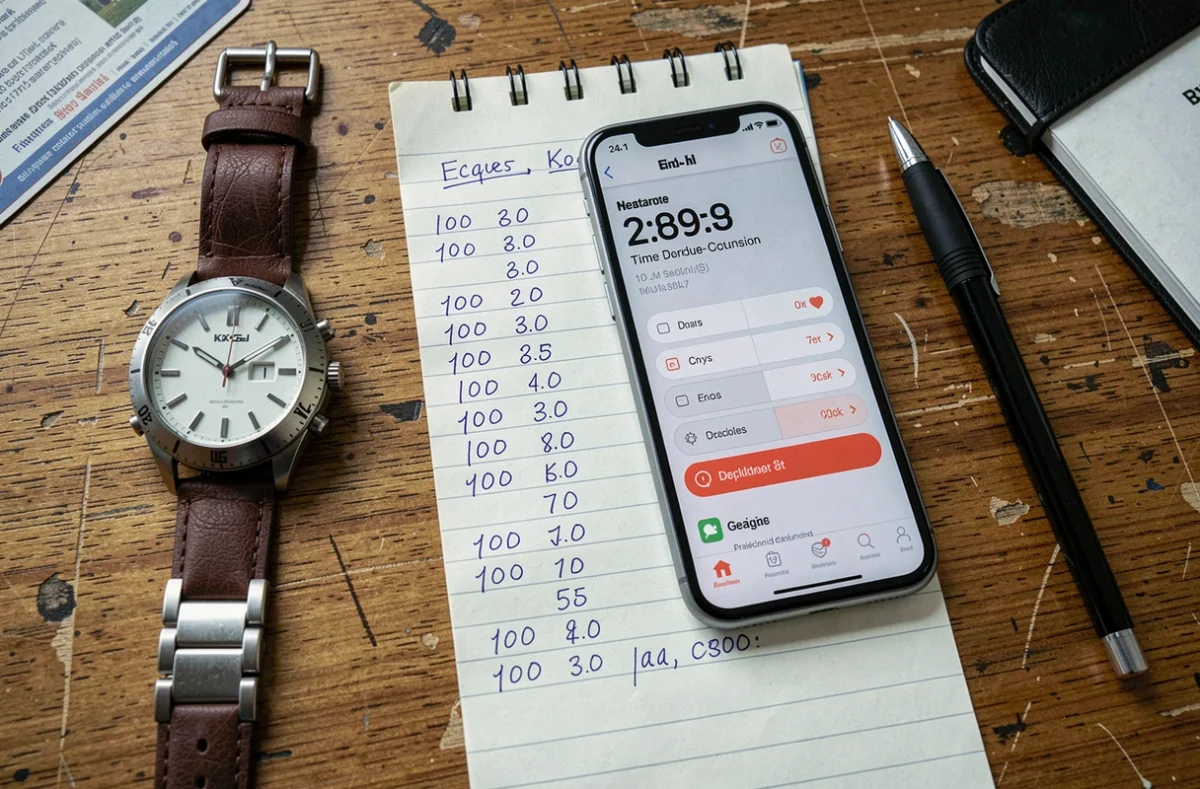
Conversion tools suited to everyday taxi work
Out on the road, you don’t open an Excel spreadsheet between fares. The most suitable tools are those that require the least effort to use.
- A printed chart tucked into the record book, listing all 60 values (0 to 59 minutes converted into hundredths): quick to check and requires no battery
- Your phone’s calculator: enter the minutes, divide by 60, and note the result next to the whole hour
- A preformatted spreadsheet on your phone or tablet, with a start-time column, an end-time column, and a cell that automatically calculates the duration in decimal format
Which option to choose depends on the number of fares and how the business consolidates its data. A company with several vehicles can save time with a shared file. A solo driver can manage perfectly well with the paper chart.
The gradual rollout of e-invoicing is a separate issue. Converting hours into hundredths helps structure time tracking, but it does not replace submitting invoicing data in the required format. The two processes complement each other but are not interchangeable.
Decimal format is essential whenever software is involved, whether for payroll, reporting, or activity tracking. For taxi professionals, getting into the habit of converting times throughout the day rather than at the end of the month remains the most reliable way to avoid discrepancies between time actually worked and time reported.