
Your first customer arrives, hands you a twenty-euro note for a two-euro book, and you have no change to give. The day starts off poorly. The cash float is a detail that many vendors overlook, yet it determines the smoothness of each sale from the very first minutes of a flea market.
Cash Float Composition: The Notes and Coins to Gather the Day Before
Preparing a cash float is not just about withdrawing a note from the ATM. It involves gathering a specific assortment of small notes and coins that cover the most common situations at a flea market stand.
The majority of items sold at flea markets are priced at psychological amounts: one euro, two euros, five euros. Your buyers will often pay with ten or twenty-euro notes. If you cannot provide change, you lose the sale or block the line.
Before choosing which cash float for flea markets suits your profile, start by estimating the average price of your items. A low-cost clothing stand requires many more one and two-euro coins than a stand selling furniture or vinyl records.
Here’s a breakdown that works for a general stand:
- Enough one and two-euro coins to provide change for about ten consecutive five-euro notes, which means at least twenty coins
- Several five-euro notes, as this is the most requested denomination to complete change for a twenty-euro note
- A few fifty-cent and twenty-cent coins if you display non-round prices (one euro fifty, three euros fifty)
- One or two ten-euro notes for the rare cases when a buyer presents a fifty-euro note
Avoid twenty-euro notes in your cash float: you will receive enough of them in the morning. It’s better to convert this amount into smaller notes and coins.

Change and Mobile Payment: Two Circuits to Separate at Your Stand
More and more buyers at flea markets are offering to pay via mobile app or card. This evolution changes how you calculate your need for change, but it does not eliminate it.
Accepting contactless payment via a terminal or an app reduces the number of cash transactions. Your cash float can then be slightly lighter. However, the very first buyers in the morning almost always pay in cash, because they arrive early, buy quickly, and do not want to wait for a flaky network connection.
If you use a mobile payment terminal, keep it in a separate place from your physical cash register. A fanny pack or a separate pouch for cash, and the terminal within reach on the other side of the stand. This separation avoids confusion and allows you to know at any time how much cash you have collected.
Should You Announce Accepted Payment Methods?
A small visible sign on your stand indicating that you accept payment by card or phone attracts buyers who might otherwise hesitate. Clearly displaying your payment methods can increase the number of sales, especially late in the morning when visitors have already spent their cash.
Securing Your Cash at a Flea Market: The Real Risk is Dispersal
At a flea market, cash theft remains rare. The most common problem is losing coins due to inattention: a note slipped into a pocket, change left on the table between two books, a buyer who leaves before you have put away the payment.
A single, closed container for all your cash resolves most of these situations. It doesn’t matter if it’s a compartmentalized bag, a metal box, or a fanny pack: the idea is to never place cash anywhere other than in this container.
A few simple habits protect your revenue throughout the day:
- Put away each payment immediately, even if another customer is waiting. Ten seconds of delay is better than a lost note
- If your stand is managed by two people, designate one person responsible for the cash to avoid double change given
- Midway through the day, remove large notes accumulated and place them in a separate, out-of-sight location to limit the amount exposed at the stand
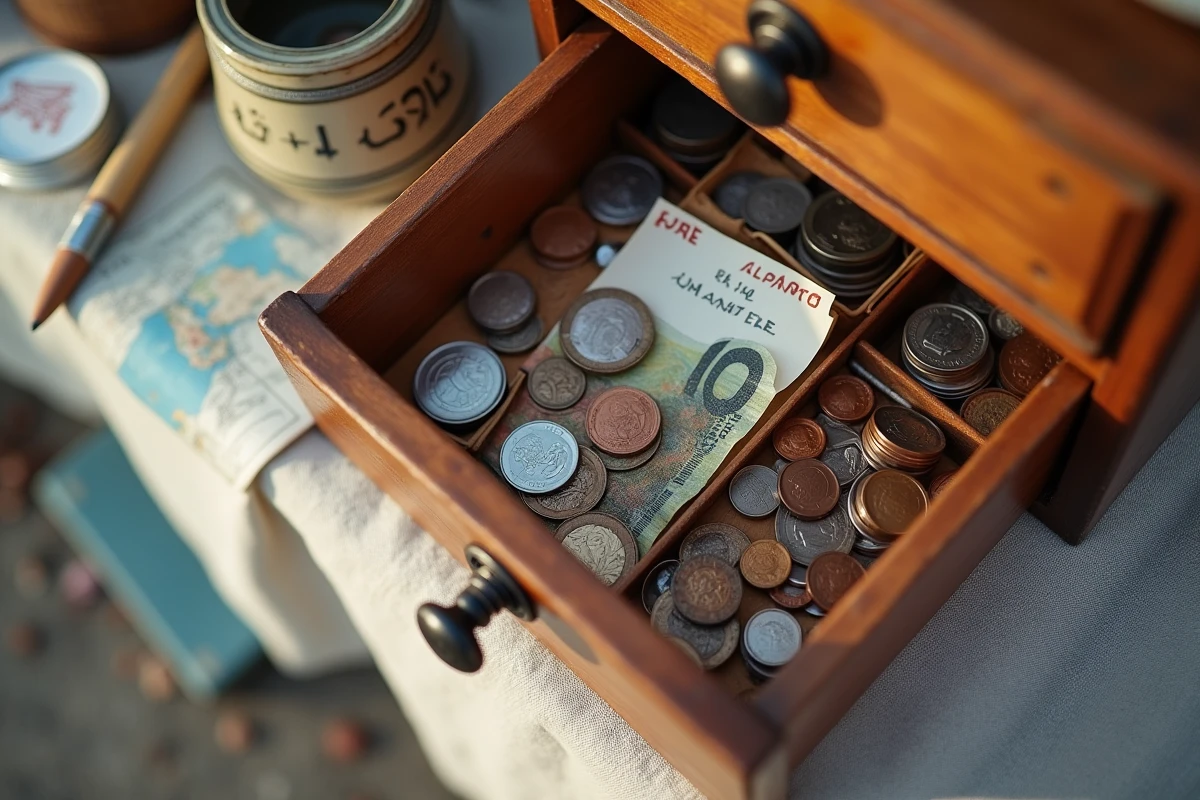
Adapting the Cash Float to the Type of Items Sold
A stand selling toys for one or two euros has different needs than a stand selling vintage furniture where the average price exceeds twenty euros. Adapting the composition of your cash float to the profile of your items prevents you from running out of coins or unnecessarily blocking cash.
Low-Priced Stand
If most of your items cost between one and five euros, plan for at least half of your cash float to be in coins. Buyers often pay with a ten-euro note for a three-euro item. You will give seven euros in coins or by combining a five-euro note with coins.
Varied-Priced Stand
When your prices range from two to fifty euros, the focus shifts to five and ten-euro notes. Coins remain useful, but most of the change will be given in notes. Still, keep a reserve of coins for small items sold at the end of the day when you are discounting to avoid packing everything up.
Whatever your profile, readjust your cash float after the first hour of sales. If your two-euro coins have dwindled, exchange a ten-euro note for change with a neighboring vendor. This mutual assistance between stands is common and rarely refused.
The ideal cash float does not exist as a universal kit. It depends on your prices, the volume of items, and your ability to accept other payment methods. Prepare it the day before, mentally test it with two or three change scenarios, and you will approach your first morning sale without stress.